On This Page
Luna Travel CPAP vs. ResMed AirMini

Our editorial process includes extensive measures to verify accuracy, provide clarity on complex topics, and present factual information. Read more
At a Glance
| Luna Travel CPAP | ResMed AirMini | |
| Best For |
Anyone seeking a budget-friendly travel CPAP with universal mask compatibility |
People who already own a ResMed mask and those who want a few extra comfort features from a travel CPAP |
| Price |
$825 |
$919 |
| Available From |
Why CPAP? And How to Choose a Travel CPAP
The most proven and effective treatment plan for sleep apnea continues to be CPAP therapy. It prevents upper airway collapse by delivering pressurized air to your breathing passages, keeping your soft palate supported. CPAP therapy works best when you use your machine every night, even when you’re on vacation.
When trying to choose a travel CPAP, think about what features you like best and decide what’s non-negotiable for travel. Then, speak to your doctor and narrow down your choices based on which machines will best address your specific needs.
Don’t Just Test Your Sleep. Understand It.
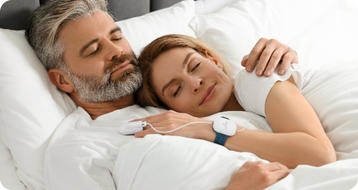
Measure key sleep metrics and review your results with a licensed sleep-care provider. Discuss sleep issues and options to make restless nights a thing of the past.


Overview: Luna Travel CPAP vs. ResMed AirMini
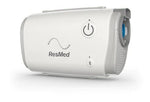
The Luna Travel CPAP machine is small, light, and vacation-ready. It can be used in either CPAP or APAP therapy modes, and it works with any CPAP mask with a 22-milimeter hose connection, which is nearly all of them. It has a ramp feature, optional DC power adapter, and a Bluetooth-capable integrated companion app. Though you can use the Luna every night, it lacks some of the comfort features that many people like, making it a better option for most people as a travel-specific, secondary CPAP machine.
The AirMini from ResMed is also lightweight and streamlined. It supports both CPAP and APAP therapy, as well as ResMed’s proprietary AutoSet for Her preset. With ramp settings, expiratory pressure relief (EPR), and an optional waterless humidification system, most users should find that it has many of the same features as their regular home CPAP machines. It has Bluetooth compatibility and a data-tracking partner app. While it’s best for travel, you can also use the AirMini as your everyday CPAP machine.
Product Specs
| Transcend Micro | ResMed AirMini | |
| Therapy Modes Options | CPAP, APAP |
CPAP, APAP, fAPAP (female-specific) |
| Dimensions (HxWxD) |
6.25” x 2.59” x 2.83” |
5.4” x 3.3” x 2.1” |
| Weight |
0.87 lbs. |
0.66 lbs. |
| Sound Level |
30 dBA |
30 dBA |
| Pressure Range |
4 to 20 cm H2O |
4 to 20 cm H2O |
| User Controls | Buttons and LightTrip app | Buttons and the AirMini app |
| Voltage Requirements | 100-240V, 50-60 Hz | 100-240V, 50-60 Hz |
| Max Altitude | 7,545 feet | 8,500 feet |
| Connectivity | Bluetooth |
Bluetooth |
| App Integration | LightTrip | myAir |
Key Differences Between Luna Travel CPAP and ResMed AirMini
- Design and size: At 0.66 pounds, the ResMed AirMini is a tad lighter than the Luna Travel CPAP at 0.87 pounds, though both are extremely light. The Luna has a cylindrical shape, while the ResMed is more of a rounded rectangle. They both fit easily on a nightstand or in a carry-on bag.
- Pressure delivery type: Both machines support CPAP and APAP therapy modes that can be switched and adjusted within their companion apps. The AirMini also has the AutoSet for Her, or fAPAP, which uses pressure settings designed to work best for women with sleep apnea.
- Comfort features: Neither machine has as many comfort features as a high-end full-size CPAP machine, but both have ramp settings and multiple therapy modes. The AirMini also has an option for added waterless humidification and an EPR setting.
- Connectivity and apps: Tech-wise, these two machines are pretty similar. They both have easy-to-use partner apps that let you adjust therapy settings and track your sleep data. You’ll need a Bluetooth connection and smart device to access either app.
- Noise level: The Luna and AirMini operate at the same decibel level, 30 dBA, which is about the same level as a whisper. There are quieter machines on the market, but unless you or your partner are very light sleepers, either of these devices should be plenty quiet.
Features
| Luna Travel CPAP | ResMed AirMini | |
| Humidifier |
No |
No, but has waterless humidification option |
| Ramp Feature |
Yes |
Yes |
| Expiratory Pressure Relief |
No |
Yes |
| Auto Start/Stop |
Yes |
Yes |
| Therapy Data |
Yes |
Yes |
Full CPAP Comparison: Luna Travel CPAP vs. ResMed AirMini
The Luna Travel CPAP and ResMed AirMini pack power into a tiny package. Both are well-made and of high enough quality that they could be used as everyday machines if needed. While they have many similarities — size, weight, and therapy modes — they do have some distinct differences.
Design and Ease of Use
The Luna and AirMini are both small, sleek, travel CPAPs that weigh under one pound, though the AirMini is slightly lighter. The Luna has a cylindrical, capsule-like shape, while the AirMini is more rectangular with rounded edges. Both are compliant with Federal Aviation Administration regulations and fit easily within a carry-on bag or personal item. They take up very little space on a nightstand.
You can start therapy with buttons on each machine, but they don’t have screens to adjust settings or controls. To make adjustments or change settings, you’ll need to pair the machines with their partner apps using Bluetooth. The apps are straightforward and user-friendly, but their necessity is something to keep in mind if you prefer using your machine without a corresponding app.
Therapy Modes and Pressure Features
CPAP and APAP modes are available on both devices, so you can get either continuous or automatically adjusting therapy options with either. In addition to APAP and CPAP, the AirMini also has fAPAP, also called AutoSet for Her: an APAP option that uses an algorithm to deliver pressure specifically designed for women’s breathing patterns.
They have the same pressure range of 4 to 20 cm H2O, which is standard for CPAP and APAP. They don’t support pressure ranges as high as most BiPAP machines, and if you use a BiPAP machine, you should check with your provider to see if either of these machines will provide high enough pressure settings.
Ramp mode is available on both devices, so you can start therapy at a lower pressure setting that’s easier to breathe against, which gradually ramps up to full pressure by the time you fall asleep. The AirMini also has expiratory pressure relief (EPR), which slightly lowers pressure to make exhaling more comfortable.
Comfort and Noise
Both the Luna and AirMini operate at about the same decibel level as a whisper: 30 dBA. They aren’t as quiet as some of the other machines that use mufflers, but unless you’re a very light sleeper, you shouldn’t notice much of a difference.
There aren’t as many integrated features on these machines as there are on many full-size CPAP machines. Because of their tiny size, they only include several comfort settings. On each machine, you can use the ramp mode to make falling asleep easier.
The AirMini’s EPR can also make exhilations more comfortable, and its option for waterless humidification is an added bonus for people who regularly use a CPAP humidifier. The Luna is a more basic machine that doesn’t include EPR or an option for humidification. Neither machine can supply heat to CPAP tubing.
Smart Features and Data Tracking
Data tracking is easy with both the Luna and AirMini through their Bluetooth-supported companion apps. The Luna uses the LightTrip app, while the AirMini works with the AirMini app. On either app, you can adjust comfort settings, check for mask leaks, and begin therapy. You can also track your sleep data and get tips to improve compliance. They are similar apps that are available on Android and iOS.
Your sleep data and compliance information are sent directly from the machines to your physicians. Neither machine has an SD slot for external data storage.
Price and Insurance Considerations
The Luna Travel CPAP is about $100 less than the AirMini, but both are under $1,000. The Luna has fewer features than the AirMini, though the added expense might be worth it if you know that you want EPR or an option for waterless humification. On the other hand, you can save some money by using the Luna if you don’t already own a ResMed mask and want to use the mask you already have, since it’s universally compatible.
Insurance coverage is different from provider to provider, so you’ll need to check with your carrier to find out the exact terms of your plan. That said, most insurance companies don’t cover secondary machines or travel CPAPs, especially if you’re buying it within 5 years of your last CPAP machine purchase. In some instances, you may be able to apply for insurance reimbursement.
If you purchase a travel CPAP directly from Sleep Doctor, you may also be able to use HSA or FSA funds. Buying from Sleep Doctor also grants you access to our team of Sleep Care Advocates, who are dedicated to improving CPAP therapy.
Don’t forget that CPAP machines require a prescription and a sleep apnea diagnosis. If you suspect that you have sleep apnea but haven’t been tested yet, the first step is an easy, at-home sleep test.
Bottom Line: Which CPAP Machine Is Better for You?
Choose the Luna Travel CPAP if you:
- Need a travel CPAP with good functionality for basic use.
- Don’t need a humidifier while you travel.
- Are looking for a budget-friendly option.
- Want a machine that’s compatible with all masks.
Choose the ResMed AirMini if you:
- Already have a ResMed CPAP mask or don’t mind buying one.
- Are OK with paying a little more to get features like waterless humidification and EPR.
- Know you want to use the AutoSet for Her therapy mode.
- Want a travel CPAP that has been on the market for a number of years.

The Sleep Doctor Forum
Real Experiences, Real Connections
Continue the discussion on the Sleep Doctor Forum. Connect with experts and fellow forum members on CPAP, sleep apnea, and all things sleep. A priceless resource that’s free to join.