For people who need more pressure support or find CPAP difficult to tolerate, BiPAP machines can provide more comfortable and adaptable therapy. While CPAP machines operate at one fixed air pressure level, bilevel positive airway pressure (BiPAP) machines use separate pressure settings for inhalation and exhalation, making them a common treatment option for people with specific sleep-related breathing disorders.
Below, we’ll share our picks for the best BiPAP machines, discuss who may be a good candidate for a bilevel device, and share key background information that can help you choose the optimal therapy device for your needs.
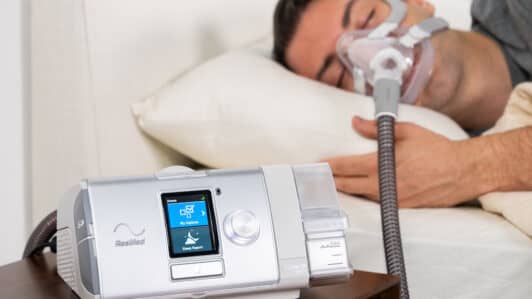
The AirCurve 10 is ideal for people who want advanced and automated features, need supplemental oxygen during sleep, and travel with a BiPAP device frequently.
Price$1,776
Dimensions10″ x 5.9″ x 4.6″
Weight2.75 lbs.
Noise Rating27 dBA
Pros
Compact, lightweight design
Built-in humidifier and optional heated tubing
Multiple therapy modes with advanced algorithms
Cons
Extensive feature list can have a bit of a learning curve
Heated tubing is sold separately
The ResMed AirCurve 10 VAuto BiPAP Machine is a compact device that offers compelling features at a competitive price point. This device has a ramp setting, allowing for a slow increase in pressure as you drift off to sleep. It's equipped with a built-in humidifier and optional heated tubing to prevent condensation. It's also compatible with supplemental oxygen.
The AirCurve 10 VAuto has a number of advanced features, including multiple BiPAP modes that use sophisticated algorithms to detect and respond to a wide range of respiratory disruptions. It also includes a central sleep apnea detection feature and ResMed’s Easy-Breathe waveform with expiratory pressure relief, which mimics the user’s natural breathing pattern.
The ResMed AirCurve 10 VAuto comes with a 2-year limited warranty. It includes a carrying case and can be powered with an auxiliary battery for taking the machine on the go.
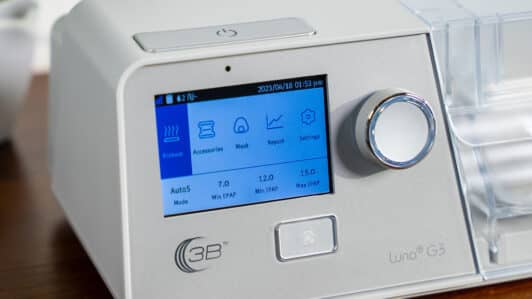
Thanks to its low decibel level and built-in humidifier, the Luna G3 BPAP 25A is ideal for light sleepers, anyone sharing a bed with a sleep partner, people who live in a dry climate, and those who want simple and convenient data sharing with their doctor.
Price$1,499
Dimensions10.4″ x 5.7″ x 4.5″
Weight3.75 lbs.
Noise Rating26 dBA
Pros
Built-in humidifier with preheat function and heated tubing
Whisper-quiet operation
Cellular mode wirelessly and automatically transmits therapy data
Cons
Not ideal for very hot or humid climates
No leak compensation
The Luna G3 BPAP 25A Machine is one of the most feature-packed BiPAP machines on the market. This device weighs just under 4 pounds and has a small footprint that fits on most nightstands.
The G3 BPAP 25A comes with a built-in humidifier to add moisture to the flow of air and help fend off dry mouth during the night. The machine also features integrated heated tubing to prevent condensation from forming in the hose and mask, and a preheat setting warms the humidifier water before use. Plus, the ramp feature starts you off with gentler pressure that gradually increases as you fall asleep.
The machine is protected by a 2-year limited warranty from the manufacturer. In addition to heated tubing, it comes with a power supply and power cord, a filter, and a travel case.
The Wellue Auto BiPAP Machine is ideal for shoppers on a budget and anyone looking for a BiPAP with higher pressure settings in a compact design.
Price$925
Dimensions9.4″ x 7″ x 5″
Weight< 3.5 lbs.
Noise Rating28 dBA
Pros
Highly competitive price for a BiPAP machine
Mask included with purchase
Higher maximum pressure than many BiPAP models
Cons
No cloud connection for uploading data
Touch screen can be sensitive
The Wellue Auto BiPAP Machine represents an excellent value for an advanced BiPAP device. This machine is below the average cost of most BiPAP machines on the market, but it’s equipped with many sophisticated features and comes with a full-face mask. Alternatively, shoppers can choose to omit the mask for a small discount.
This device includes a built-in heated humidifier and a ramp function that lets users ease into their prescribed therapy pressures. It also features multiple BiPAP operating modes, including spontaneous and spontaneous-timed modes and two auto-adjusting modes.
The Wellue Auto BiPAP Machine has the ability to run at a higher pressure than most BiPAP machines, reaching up to 30 cm H2O. The machine also records therapy data to an SD card that’s compatible with PC software.
The sleek touch-screen design and auto start and stop functions make the Wellue Auto BiPAP Machine easy and straightforward to use. It has a relatively small footprint and weighs less than 3.5 pounds. The device is backed by a 2-year manufacturer’s warranty.
How We Make Our Picks
To recommend the best BiPAP machines, we rely on our team’s experience and knowledge. In addition to Michael Breus, PhD, a.k.a. The Sleep Doctor, our team includes medical professionals and product experts with decades of experience. We combine their collective expertise with verified customer reviews and product analysis.
Because BiPAP machines have a different intended user than CPAP machines, we pay particularly close attention to reviews from people who use high pressure settings. Our researchers also comb peer-reviewed articles for new information and recall updates.
What Is a BiPAP Machine?
A BiPAP machine is a medical device that sends pressurized air into the upper airway through a hose and a mask in order to stabilize breathing and treat sleep apnea and other sleep-related breathing disorders. A defining feature of a BiPAP device is its ability to deliver different levels of air pressure when inhaling and exhaling.
Most BiPAP machines come with tubing, a power supply and power cord, and an air filter. Some BiPAP devices include a built-in humidifier with a removable water chamber, though humidifiers are also available individually.
Masks are typically sold separately. Products marketed as CPAP masks are generally compatible with other types of PAP machines.
One of the major aims of a BiPAP is to make higher pressure settings comfortable. Think about what else will make your BiPAP a better fit, whether that’s a built-in humidifier, a high-quality mask, or heated tubing.
BiPAP vs. CPAP Machines
The main difference between BiPAP and CPAP machines is that CPAP machines have one pressure setting while BiPAP devices have a higher pressure setting for breathing in and a lower pressure level for breathing out.
BiPAP and CPAP machines are fairly similar in appearance, but their differing pressure settings can have significant impacts for treating sleep apnea and other breathing-related conditions. Make sure to discuss your symptoms and unique needs with your healthcare provider to determine the treatment that’s best for you.
CPAP
BiPAP
Ideal for
People with obstructive sleep apnea trying PAP therapy for the first time
Individuals with OSA who do not have other breathing problems or significant medical issues
People with OSA who haven’t responded well to CPAP therapy
Those with more complex breathing issues during sleep
May not work for
Those who find fixed pressure uncomfortable
People with both sleep apnea and additional respiratory conditions
People who have mild sleep apnea or who are just starting PAP therapy
Some people with central sleep apnea linked to a specific type of heart failure
Using BiPAP Therapy for Sleep Apnea
To use a BiPAP machine, you wear a mask that's attached to the device by a hose. Pressurized air is sent through the tubing and into your upper airway, which helps prevent breathing interruptions during sleep. The main feature that distinguishes a BiPAP machine from other types of PAP machines is that it has separate pressure settings for when you breathe in and breathe out.
BiPAP therapy may be recommended to treat different types of sleep apnea, including obstructive sleep apnea, central sleep apnea, and complex (or mixed) sleep apnea.
Obstructive sleep apnea (OSA): Obstructive sleep apnea occurs when the airway becomes temporarily blocked during sleep.
Central sleep apnea (CSA): Central sleep apnea occurs when the brain’s process of controlling breathing becomes disrupted. Some people also experience Cheyne-Stokes respirations, a condition characterized by an alternating pattern of shallow breathing and hyperventilation.
Complex sleep apnea: Referred to as treatment-emergent central sleep apnea by medical experts, this is a type of CSA that can arise in people with OSA undergoing PAP therapy.
While BiPAP therapy is a potential treatment option for these types of sleep apnea, it isn't often the first type of therapy that's recommended. In many cases, a BiPAP machine is only prescribed after CPAP therapy has already been tried.
Types of BiPAP Machines for Sleep Apnea
While the common denominator of all BiPAP machines is the delivery of different air pressure levels for inhalation and exhalation, some models include algorithms that detect breathing patterns and make various adjustments in real time.
Fixed-pressure BiPAP: This type of BiPAP machine has fixed air pressure levels for when you breathe in and breathe out. These settings are determined during an overnight titration study where sleep technologists directly observe how well the machine is helping your breathing and adjust its settings accordingly.
Auto-adjusting BiPAP: Some BiPAP devices are auto-adjusting, which means they use specially designed software to recognize breathing patterns and adjust the pressure levels in response. The initial settings for an auto-adjusting BiPAP machine are generally still determined during a lab-based titration study.
Are There Travel BiPAP Machines?
While travel CPAP machines are common, there are fewer travel BiPAP machine options available. However, several manufacturers offer compact, lightweight BiPAP models that are better suited to being stowed away, taken on the road, and powered with an external battery.
Even though there aren’t as many travel options for BiPAP machines as there are for CPAPs, you can still find bi-level machines small enough for on the go use. Some have battery power options, too.
What to Consider When Choosing a BiPAP Machine
To find the best BiPAP machine for you, it’s important to consider your priorities and needs for sleep apnea treatment. Before buying a new machine, think about your price range, how much space you have available, and what advanced features are most important to you.
Pricing and Size
BiPAP machines can vary widely in price, usually costing between $1,700 and $3,000. More expensive models typically offer more complex features. In general, BiPAP machines cost more than CPAP machines because they have a more diverse range of functions and pressure settings.
Most BiPAP machines are rectangular and measure less than a foot long. Although they are larger than a standard alarm clock, BiPAP machines are normally small enough to fit on a nightstand or bedside table.
Pressure Ranges and Noise Levels
Most BiPAP machines can provide pressure levels from 4 to 25 centimeters of water pressure (cm H2O), which is a common measure of air pressure for PAP devices. Some BiPAP devices max out at 30 cm H2O.
Modern BiPAP machines are relatively quiet when running. The quietest machines generate only 25 to 30 decibels, a sound level equivalent to a whisper.
Data Tracking and Other Features
Many BiPAP machines can track and store key data, including how long you use your machine, sleep duration, pressure statistics, quality of mask seal, and sleep apnea events per hour.
Reduced pressure at the start of the night may make it easier to fall asleep. A ramp setting starts the machine at a lower pressure and slowly increases the pressure level over a set period.
Other smart features include cellular connectivity, preheat settings for humidifiers, auto-adjusting screen brightness, and automatic start and stop sensors that detect when your mask is in place.
BiPAP Programmable Modes
While the ability to switch between higher and lower pressure settings for inhalation and exhalation is standard for BiPAP machines, some devices include more advanced algorithms designed to meet specific breathing needs.
Spontaneous mode (S): The machine only uses the cues from a person’s breathing to adjust between the different pressure levels.
Timed mode (T): The machine uses a fixed time period to cycle between the pressure level for breathing in and out. Unless a person struggles to breathe on their own, it's rare for timed mode to be used.
Spontaneous-timed mode (S/T): The machine uses cues from a person’s breathing to adjust the pressure, but there’s a fail-safe — often called a backup rate or backup breath — that increases the air pressure if the machine doesn’t detect that the user has inhaled within a set period of time.
How to Buy a BiPAP Machine
BiPAP machines are a form of medical equipment. This means there are some rules and regulations to navigate during the purchasing process.
Do You Need a Prescription for a BiPAP Machine?
The U.S. Food and Drug Administration (FDA) classifies PAP machines, including BiPAP devices, as class II medical devices. While this designation ensures that BiPAP machines meet certain safety standards, it also means that a prescription is required.
If you take a home sleep test through Sleep Doctor, your test is reviewed by a licensed physician who can prescribe CPAP therapy if needed, making it easier to obtain a mask and begin treatment without additional office visits.
Does Health Insurance Cover BiPAP Costs?
Health insurance coverage for BiPAP expenses can be less straightforward than CPAP therapy. Some providers may only cover a portion of BiPAP costs if a person’s apnea-hypopnea index (AHI) score — a measure of sleep apnea severity — exceeds a certain threshold. Additionally, some plans only provide BiPAP coverage if it's been demonstrated that a person has first unsuccessfully tried CPAP therapy.
Check with your insurance provider regarding your plan’s PAP therapy specifics and coverage requirements.
Where Can You Buy a BiPAP Machine?
BiPAP machines are available from online and brick-and-mortar medical equipment providers, as well as retailers that specialize in CPAP devices and accessories. Sleep Doctor offers a curated selection of BiPAP machines that can be purchased after receiving a valid prescription, along with guidance to help you choose equipment that fits your therapy needs.
Buying a BiPAP machine in person lets you see the equipment and pose questions to sales staff. Online stores generally have a larger selection of machines and often have lower prices. Stores that offer CPAP and BiPAP machines typically sell other therapy accessories, including masks, tubing, filters, and optional supplies like CPAP batteries.
How Do You Clean a BiPAP Machine?
Because it delivers air for you to breathe, it’s important to keep your BiPAP machine clean. This helps prevent bacterial growth and can extend the life of your BiPAP device and components.
In general, BiPAP machine accessories should be cleaned with warm water and mild soap. While the following are general cleaning guidelines, refer to user manuals for specific manufacturer’s instructions regarding cleaning methods and frequencies.
Machine: Unplug the device and wipe down the outside with a nonabrasive cloth about once per week.
Mask: Use mild soap and a damp cloth to gently clean your mask every day. Alternatively, specially designed CPAP wipes can be used for daily mask maintenance. Once a week, take your mask apart and wash all the components more thoroughly in warm water and a mild detergent. Allow everything to air-dry completely out of direct sunlight before reassembling the mask.
Headgear: Take apart the headgear and straps from your mask and hand-wash them once a week or anytime they appear dirty.
Tubing: Wash the hose thoroughly once a week and hang it up to fully dry.
Humidifier water chamber: Empty the water tank every morning and wash it roughly once per week. Only fill the chamber with distilled water, as other types of water can cause mineral buildup.
Filters: Follow the manufacturer’s recommended schedule for replacing your filter. If you have a reusable filter, wash it once a week and replace it according to the manufacturer’s suggested time frame.
Avoid using abrasive cleaners like rubbing alcohol or bleach that can damage your BiPAP machine and accessories. The FDA has cautioned against using ozone gas or ultraviolet light cleaners, as the agency hasn’t cleared or approved these products, nor has it made a determination regarding their safety and efficacy.
Alison is a health writer with ample experience reading and interpreting academic, peer-reviewed research. Based in San Diego, she is published in the journal PLOS Genetics and the Journal of Biological Chemistry and has been a copywriter for SmartBug media. With a master’s degree in biochemistry from the University of California, Davis, she has nearly a decade of academic research experience in life sciences. She enjoys helping people cut through the noise to understand the bigger picture about sleep and health. Alison likes to stay active with rock climbing, hiking, and walking her dog.