Breathing continues automatically while you sleep, and the rate at which it happens can reveal important clues about your health and sleep quality. Sleep respiratory rate refers to the number of breaths you take per minute during sleep and is influenced by factors such as sleep stage, fitness level, illness, and underlying respiratory or sleep conditions.
Tracking changes in this metric over time — rather than focusing on a single night — can help identify patterns that may be worth discussing with your doctor.
Below, we'll discuss the significance of your respiratory rate during sleep, how your respiratory rate may be influenced by medical conditions, and when you should contact a medical professional.
What Is a Normal Sleep Respiratory Rate?
The body continually adjusts the pace of breathing to ensure the body’s cells can produce the right amount of energy. When a person is asleep, their respiratory rate generally slows compared to when they're awake. Also, a person’s sleep respiratory rate naturally changes throughout the night, depending on what stage of sleep they're in.
A person’s breathing frequency during sleep depends on a number of factors, including their age, activity level, and whether they have certain health conditions. But, on average, these are the established normal sleep respiratory rate (breaths per minute, or brpm) by age:
- Infants and children: Typical respiration rates in newborns are about 44 breaths per minute, which slows to around 26 breaths per minute by 2 years old.
- Adults: The respiration rate for average, healthy adults at rest is around 12 breaths per minute. Older adults may have a slightly higher respiratory rate.
| Age Range | Average Sleep Respiratory Rate (brpm) |
| 0 to 3 months | 34 to 57 brpm |
| 3 to 12 months | 30 to 55 brpm |
| 1 to 2 years | 25 to 46 brpm |
| 2 to 3 years | 22 to 34 brpm |
| 3 to 6 years | 20 to 29 brpm |
| 6 to 12 years | 16 to 24 brpm |
| 12 to 17 years | 13 to 21 brpm |
| 18 to 65 years | 12 to 20 brpm |
| 65 to 79 years | 12 to 28 brpm |
| 80 years and older | 10 to 30 brpm |
Respiratory Rate During REM Sleep
In the fourth stage of sleep, called rapid eye movement (REM) sleep, a person’s respiratory rate becomes less stable and increases along with other measurements like blood pressure and heart rate. People tend to experience more vivid dreams during REM sleep, as they rapidly move their eyes behind closed eyelids.
During REM, the part of the brain that regulates breathing becomes less responsive and many breathing muscles become temporarily inactive. Together, these shifts account for continual changes in respiration rate during REM sleep.
For most people, normal changes in respiratory rate during REM sleep don't pose a problem. However, changes in breathing during sleep may be problematic for people diagnosed with a health condition that affects breathing, such as asthma.
Don’t Just Test Your Sleep. Understand It.
Measure key sleep metrics and review your results with a licensed sleep-care provider. Discuss sleep issues and options to make restless nights a thing of the past.


How Do You Measure Respiratory Rate While Sleeping?
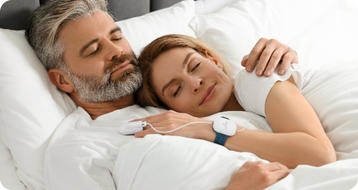
Respiratory rate can be measured in a variety of ways. In most healthcare settings, capnography is the standard way to measure respiratory rate. In capnography, respiratory rate is measured using a tube that's inserted into the nose or mouth.
A person’s respiratory rate can also be manually detected using a stethoscope and counting the number of breaths taken in one minute. Pulse oximeters, used to measure oxygen in the blood, can also be used to calculate a person’s respiratory rate. Some wearable devices, like fitness trackers, are also able to measure vital signs like pulse and respiratory rate.
A sleeper’s respiratory rate is a standard measurement taken during polysomnography, also called a sleep study. During a sleep study (which can also be done at home in many cases), special sensors are used to track respiratory rate through the night.
What Causes an Abnormal Sleep Respiratory Rate?
A person’s respiratory rate can also be affected by several sleep-related breathing disorders, a category of sleep disorders in which a person’s respiration becomes abnormal during sleep.
- Obstructive sleep apnea: Obstructive sleep apnea (OSA) describes a sleep disorder in which breathing stops or slows because of an obstruction in their airway. OSA can cause a person to have an abnormally low respiratory rate or stop breathing for more than 10 seconds during sleep.
- Central sleep apnea: In central sleep apnea (CSA), respiration is slowed or paused due to a disruptions in signals from the brain. In CSA with Cheyne-Stokes breathing, there is a lapse in breathing, followed by an increase and then a decrease in respiratory rate. In CSA due to high altitude, respiratory rate increases or decreases as a result of an increase in elevation.
- Sleep-related hypoventilation disorders: A person with a sleep-related hypoventilation disorder has breathing that is too slow or too shallow. While these disorders can also affect breathing during the day, hypoventilation is typically worse while a person is asleep.
Causes of Low Respiratory Rate During Sleep
A low respiratory rate is also called bradypnea or hypoventilation. While low respiratory rates aren't always related to an underlying medical condition, bradypnea may be caused by medications or illicit drugs, sleep disorders, and medical conditions, including:
- Hypothyroidism
- Injury to the brain stem
- Brain stem tumors
- Heart conditions and cardiac arrest
- Drug use or overdose
Causes of High Respiratory Rate During Sleep
A high respiratory rate is called tachypnea, but may also be referred to as hyperventilation. An abnormally high respiratory rate can be caused by certain medications, sleep disorders, and medical conditions such as:
- Asthma
- Chronic obstructive pulmonary disease (COPD)
- Heart failure
- Pneumonia
- Anxiety or stress
- Obesity
When to Talk to Your Doctor
Talk to your doctor if you have concerns about your breathing or find that your respiratory rate is outside of the healthy range for your age group, whether taken during sleep or awake and at rest.
While you should talk to a doctor about any concerns related to breathing patterns, there are certain symptoms that warrant immediate medical attention, including:
- Sudden changes in breathing
- Difficulty taking a breath
- Blue or gray coloring of the skin, nails, gums, lips, or eyes
- Chest pain
- Fever
- Loss of consciousness
- Seizure
- Pain or bleeding
Frequently Asked Questions
Generally, experts view a respiratory rate that falls between 12 and 20 breaths per minute to be healthy for adults at rest. Infants and toddlers generally have higher respiratory rates, however, as do older adults.
Most people do not check their sleep respiratory rate at home. If someone you share a bed with notes that your breathing is unusually slow or occasionally stops as you sleep, this could be a sign of a sleep disorder. A doctor is in the best position to decide whether or not it would be helpful to monitor your respiratory rate at home.
If you learn your respiratory rate consistently falls outside of the 12 to 20 range during sleep, consider making an appointment with your doctor. Although an abnormal respiratory rate might not indicate any underlying problem, it's important to seek professional medical attention to rule out the possibility of other issues.