In the United States, roughly 30 million people live with the symptoms of sleep apnea without realizing that they have it. If you're one of those people who snore, snort, gasp, or choke in your sleep, an at-home sleep apnea test offers a convenient way to diagnose sleep apnea without spending the night in a sleep lab.
Obstructive sleep apnea (OSA) is a sleep disorder that causes a person to stop breathing for brief periods because of a partial or total blockage of the upper airway. Untreated OSA can cause poor-quality sleep and daytime sleepiness, but it also increases the risk of many serious chronic health conditions.
That’s why early diagnosis matters. Below, we’ll walk you through how at-home sleep apnea tests work, who they’re best suited for, and what you can expect from the testing process.
What Is an At-Home Sleep Study?
An at-home sleep apnea test is a method of diagnosing obstructive sleep apnea in a person’s home, rather than in a sleep laboratory. This test uses a portable device to measure breathing and other health signs while a person sleeps.
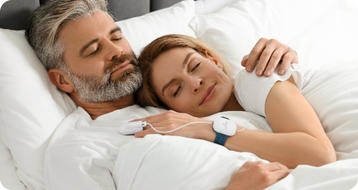
For example, the Sleep Doctor Home Sleep Test (HST) measures a number of variables using only a device worn like a wristwatch, a finger clip, and a chest sensor. These variables include your heart rate, blood oxygen level, snoring, and chest motion. While you sleep, the Sleep Doctor HST records this data. Then it transmits the data to a sleep doctor using your cell phone’s Bluetooth signal.
What It Measures
A home sleep apnea test collects key data related to breathing and oxygen levels while you sleep. Although it doesn’t measure as many variables as an in-lab sleep study, it provides enough information for a doctor to evaluate suspected obstructive sleep apnea. Most at-home sleep tests measure:
- Breathing patterns, including snoring and pauses or reductions in airflow
- Respiratory effort, or how hard your chest works to breathe
- Oxygen saturation levels to detect drops linked to apnea events
- Heart rate, which can change during breathing interruptions
- Body position (side, back, or stomach)
- Peripheral arterial tone (PAT), the change in blood volume in your finger artery
Some at-home tests, called type 3 devices, measure as many as seven variables. Others, called type 4 devices, measure only up to three variables.
Home Sleep Test vs. In-Lab Sleep Study
At-home sleep apnea tests are different from sleep disorder testing called polysomnography (PSG). A PSG takes place in a sleep laboratory or sleep clinic, and a technician stays in the lab to monitor the person as they sleep.
While a PSG is considered the most accurate means of diagnosing obstructive sleep apnea, at-home testing may be a good alternative for certain people. These include people whose symptoms suggest that they have moderate or severe OSA and who don’t have other medical conditions that can affect their breathing while they sleep.
Doctors don't typically recommend at-home sleep apnea testing for people who may have other sleep disorders, such as narcolepsy or insomnia, or for people whose jobs require them to be alert as a matter of public safety.
Don’t Just Test Your Sleep. Understand It.
Measure key sleep metrics and review your results with a licensed sleep-care provider. Discuss sleep issues and options to make restless nights a thing of the past.


How Does a Home Sleep Study Work?
At-home sleep apnea tests use sensors attached to a person’s body to measure certain variables while they sleep. These measurements can provide doctors with the information needed to diagnose obstructive sleep apnea.
The number of sensors and types of measurements depends on the specific test device. The device may collect measurements using a wrist band, finger clip, chest strap, nasal cannula, and/or sensors placed on the chest or neck.
Here's how the Sleep Doctor Home Sleep Test works:
- Order your test online: You may also need to complete a brief telehealth visit with a licensed physician who reviews your symptoms and can approve the at-home sleep test.
- Receive your test in the mail: Sleep Doctor ships you a disposable, FDA-approved testing kit that includes a wristband, finger probe, and chest sensor.
- Set up the device: Following written or app-based instructions, you put on the wristband, attach the finger probe, and secure the chest sensor.
- Sleep normally overnight: The test runs throughout a full night, collecting data on breathing patterns, oxygen saturation, heart rate, movement, snoring, and body position.
- Data automatically uploads: Once complete, the recorded data is transmitted via the companion app to a certified sleep physician who interprets the results.
- Receive your sleep report: In a follow-up virtual consultation, your Sleep Care Advocate will review your results and recommended next steps (ex. CPAP therapy or oral appliances).
Is an At-Home Sleep Apnea Test Right for You?
An at-home sleep apnea test can be a good option for people who have symptoms of OSA and want a convenient way to get evaluated. However, home testing isn’t right for everyone.
Understanding who benefits most from an at-home test—and when an in-lab sleep study may be more appropriate—can help you choose the best path to an accurate diagnosis and effective treatment.
Who's a Good Candidate
If your doctor suspects that you have moderate or severe obstructive sleep apnea, and if you don’t have any characteristics that could interfere with the at-home test results, you might be a good candidate for an at-home sleep apnea test.
At-home sleep apnea testing may be an attractive option if you're unable to make an appointment at a sleep clinic or if the only appointments available are too far in the future. You may also simply prefer to stay in the comfort of your home, where you're used to sleeping.
An at-home sleep test is significantly more comfortable and a lot less disruptive to the sleep itself. The test data may be limited in comparison to a lab, but it will be an overall easier testing experience for you.
Benefits of Doing a Home Sleep Test
At-home sleep apnea tests can offer several benefits. These tests can be:
- Performed in the comfort of your home
- Convenient and easily accessible
- More affordable
- Arranged around your schedule
- Less time-consuming
- Discreet
Having the option of taking the test at home also removes barriers for people who are reluctant to spend time in a sleep lab. This could lead to OSA being effectively controlled in people who otherwise wouldn't be diagnosed at all.
Disadvantages of Home Sleep Testing
Besides the potential benefits, there are a few possible drawbacks to taking a sleep apnea test at home.
- Slightly less accurate: Although at-home tests continue to improve, they're still considered less accurate than an in-lab sleep study, especially for mild cases.
- No overnight support: At-home sleep apnea tests are not attended by trained sleep professionals who can give advice or help with adjusting or repositioning the equipment.
- Incomplete data: At-home tests cannot collect as much information as in-lab polysomnography. Thus, home tests may give an incomplete picture of a person’s sleep and can’t help to diagnose other sleep disorders a person may have.
Who Likely Needs In-Lab Testing
In general, doctors won't recommend home sleep apnea testing if they think you could have another sleep disorder, heart failure, chronic obstructive pulmonary disorder (COPD), regular opioid use, or a history of stroke.
Also, if your job could endanger yourself or other people if you can’t stay alert, your doctor will likely recommend a more sensitive sleep study in a lab. If you are a taxi or bus driver, police officer, airline pilot, or another “mission-critical” worker, becoming drowsy because of a missed OSA diagnosis could put lives at risk.
It’s worth keeping in mind that taking an at-home test doesn't guarantee that you’ll avoid polysomnography. If an at-home test has negative results but your doctor still thinks you could have OSA, they may recommend that you have follow-up testing in a sleep lab.
How Do You Prepare for a Home Sleep Study?
On the day that you take an at-home sleep apnea test, it’s important to set yourself up for a good night’s sleep so that the test will successfully collect enough data. This can involve paying attention to several features of your daily routine.
- Medications: Unless your doctor has advised you otherwise, continue taking any medications you usually take.
- Alcohol: Unless your doctor has advised you otherwise, avoid drinking alcohol the day of the sleep apnea test.
- Caffeine: Stay away from caffeinated drinks such as tea, soda, and coffee during the afternoon and evening hours.
- Hair and body products: Hair gel, body lotion, face makeup, and similar products might make it harder for test sensors to stay in place.
- Napping: Try not to nap on the day of the test.
What Do You Your Home Sleep Test Results Mean?
Anyone who takes a sleep apnea test at home should go over their test results with their doctor. Home test devices provide raw data for your sleep doctor to analyze, but they don't diagnose OSA on their own.
When your doctor discusses your results with you, they may bring attention to your apnea-hypopnea index (AHI). The AHI represents your average number of breathing disruptions for each hour you have slept during the test. Doctors use AHI in diagnosing OSA and to determine how severe the condition is.
If your at-home sleep apnea test result is negative or inconclusive, but your doctor still suspects obstructive sleep apnea, they may order a sleep apnea test performed in a sleep lab. Some health insurance providers require a second negative at-home sleep apnea test before covering for polysomnography at a sleep lab.
What Is the Best At-Home Sleep Apnea Test?
There are various home sleep apnea tests that you or your doctor may select to evaluate you for OSA, with each using different equipment and processes. The Sleep Doctor Home Sleep Test is among the most advanced options available and is an excellent choice for people over the age of 18.
Sleep Doctor offers customer support as well as sleep coaching for people diagnosed with sleep apnea after using the test. Customers have offered praise for the Sleep Doctor HST’s comfort and price, as well as for how easy they’ve found it to use.
Frequently Asked Questions
Are at home sleep studies accurate?
At-home sleep studies can be accurate for diagnosing moderate to severe obstructive sleep apnea in adults who have a high likelihood of the condition. The Sleep Doctor Home Sleep Test is 98% accurate in diagnosing sleep apnea compared to an in-lab sleep study.
However, home tests are not as comprehensive as in-lab sleep studies and may miss mild sleep apnea or other sleep disorders. If test results are inconclusive or symptoms persist, a doctor may recommend an in-lab study.
How much does an at-home sleep study cost?
The cost of a home sleep study typically falls in the range of a few hundred dollars when paying out of pocket, though pricing varies based on the provider and what services are included. For example, the Sleep Doctor HST costs $189.
Some insurance plans, including Medicare and private insurers, may cover part or all of the cost when the test is medically necessary. If not, you may be able to use HSA or FSA funds to reimburse the cost. It’s a good idea to check with your insurance provider to understand coverage and potential out-of-pocket expenses.
Can a home sleep study detect central sleep apnea?
At-home sleep studies aren't designed to reliably detect central sleep apnea. Most home tests focus on airflow and breathing effort and may not accurately distinguish between obstructive and central events.
If central sleep apnea is suspected, an in-lab polysomnography is usually recommended, as it provides more detailed monitoring of brain activity and breathing control.