On This Page
Apnea-Hypopnea Index (AHI) and Sleep Apnea

Our editorial process includes extensive measures to verify accuracy, provide clarity on complex topics, and present factual information. Read more
Key Takeaways
- Apnea-hypopnea index (AHI) is a number collected during sleep studies that indicates how many breathing disruptions someone has per hour of sleep.
- The AHI helps doctors determine the existence and severity of sleep apnea.
- AHI is usually interpreted along with other factors including respiratory disturbance index (RDI) and oxygen desaturation index (ODI).
- Treating sleep apnea with methods like positive airway pressure (PAP) therapy can help lower AHI scores.
What Is AHI?
AHI is the apnea-hypopnea index, a measurement that describes the severity of breathing disruptions during sleep. A person’s AHI is an important tool because it provides doctors with an objective measurement of abnormal nighttime breathing. It measures:
- Apneas: An apnea is a near or total pause in breathing that reduces a person’s airflow by at least 90% for at least 10 seconds.
- Hypopneas: A hypopnea describes a decrease in airflow that’s less severe than an apnea. What qualifies as a hypopnea can vary based on the sleep clinic performing the test.
- Total sleep time: The total sleep time is the amount of time the patient stays asleep while apneas and hypopneas are being measured.
AHI is calculated using data collected during an overnight medical test called a sleep study. Doctors use the AHI to diagnose sleep apnea and determine its severity. A higher AHI corresponds to more frequent breathing disruptions and a potential diagnosis of sleep apnea.
Not all breathing issues during sleep are indicative of sleep apnea. It’s normal to experience occasional, short lapses in breathing during sleep. The AHI score helps a healthcare provider determine whether nightly breathing patterns are benign or if they could be impacting your sleep and overall health.
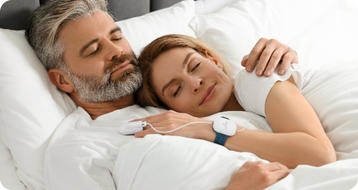
Don’t Just Test Your Sleep. Understand It.
Measure key sleep metrics and review your results with a licensed sleep-care provider. Discuss sleep issues and options to make restless nights a thing of the past.


How Is AHI Calculated?
AHI = (number of apneas + number of hypopneas) / total sleep time in hours
To calculate AHI, doctors divide the number of apneas and hypopneas that occur by the total hours of sleep. The result provides a measurement of breathing disruptions per hour of sleep.
Sleep specialists measure AHI using data collected during a sleep study, increasingly via an at-home sleep apnea test. A sleep study is a test that usually takes place overnight at a specialized sleep clinic. A sleep study involves monitoring a variety of body functions during sleep. The results of a sleep study can help identify and diagnose sleep disorders like sleep apnea.
After a sleep study, a specialist interprets all of the data that was collected. The wide range of data provided by a sleep study allows a specialist to understand a person’s sleep quality and nighttime breathing patterns.
If a sleep study detects breathing disruptions, each event is classified as either an apnea or a hypopnea. Apneas and hypopneas are also classified as obstructive, central, or mixed.
- Obstructive apneas describe breathing disruptions in which the sleeper continues to try to breathe despite a narrow or closed airway.
- Central apneas occur when a sleeper makes no effort to breathe.
- Mixed apneas involve qualities of both obstructive and central apneas.
What Does Your AHI Score Mean?
The AHI score helps doctors measure the severity of obstructive sleep apnea (OSA) in both children and adults.
Generally, an AHI of less than 5 is considered normal for an adult. This is because most adults experience brief periods when their breathing is interrupted or blocked during sleep.
An AHI of 5 or greater may indicate that a person has sleep apnea. However, to diagnose this disorder doctors also consider a person’s medical history, the results of a physical exam, and other measurements collected during the sleep study.
To understand the type of sleep apnea detected during a sleep study and its severity, the AHI is further broken down into an obstructive AHI and a central AHI.
| Obstructive AHI in Adults | Obstructive AHI in Children | |
|
Mild OSA |
5 to 14 |
1 to 4.9 |
|
Moderate OSA |
15 to 30 |
5 to 9.9 |
|
Severe OSA |
Greater than 30 |
10 or greater |
AHI in Children and Teens
The AHI comes with several caveats when evaluating children and adolescents for sleep apnea. For example, the threshold used to determine the severity of OSA differs significantly between children and adults. There’s also less consensus in the medical community about how to best use the AHI in children.
Clinical practice has helped some experts define the AHI ranges for mild, moderate, and severe OSA in children, but more research is needed. As a result, pediatricians must look at a child’s entire medical history and sleep study results before making a diagnosis.
Additionally, the difference in AHI thresholds between children and adults may lead to confusing results in teens. Healthcare providers can use the AHI ranges for either adults or children with teens aged 13 to 18, but the adult AHI’s higher threshold may result in some teens with OSA going undiagnosed.
Obstructive Apnea-Hypopnea Index
Obstructive sleep apnea (OSA) is the most common form of sleep apnea. This condition is caused by a collapse of the airway during sleep. To diagnose OSA, doctors consider a person’s obstructive AHI, which is their AHI calculated using only apneas and hypopneas that are obstructive and excluding any central apneas.
The threshold for diagnosing OSA depends on a person’s symptoms and the presence of any health complications caused by this disorder. Someone with an obstructive AHI between 5 and 14 may be diagnosed with mild sleep apnea if they also have other symptoms or a co-occurring health condition. People without symptoms or health effects of OSA require an obstructive AHI of at least 15 to receive this diagnosis.
Once diagnosed, OSA is described as mild, moderate, or severe. It’s important to note that AHI is interpreted differently in children, and the threshold for diagnosing OSA in children is lower than in adults.
Central Apnea-Hypopnea Index
Central sleep apnea (CSA) is the less common form of sleep apnea. CSA is often caused by an underlying health condition that interferes with signals from the brain that control breathing muscles. To diagnose CSA, doctors consider several factors, including a person’s medical history, symptoms, and the results of a sleep study.
The central AHI is calculated using only central apneas and hypopneas and excluding any obstructive breathing disruptions. Central sleep apnea may be diagnosed when a person has a central AHI of 5 or more.
Though a person can have both CSA and OSA, doctors may diagnose CSA if more than half of the apneas and hypopneas are central in nature.
What Else Matter When Interpreting AHI?
The AHI helps quantify a person’s breathing issues as they sleep, but it’s not the only measurement used to evaluate sleep apnea. Doctors can also learn about breathing issues by examining other measurements taken by the sleep study.
Respiratory Disturbance Index (RDI)
The respiratory disturbance index (RDI) is a measure used in sleep studies to indicate the number of breathing disruptions per hour of sleep, including apneas, hypopneas, and other events that disturb breathing without fully meeting apnea criteria.
The key difference between the AHI and the RDI is that RDI accounts for respiratory effort-related arousals in addition to apneas and hypopneas. Respiratory effort-related arousals are seen during a sleep study as brief awakenings that occur after a change in breathing.
There’s no consensus in the medical field on whether the AHI or RDI is better for diagnosing sleep apnea. Some experts prefer the RDI when evaluating OSA because it provides information about sleep interruptions and may accurately detect this sleep disorder more often.
Oxygen Desaturation Index (ODI)
The oxygen desaturation index (ODI) measures the average number of times that the blood oxygen level drops per hour during sleep. Any drop below 90% saturation is considered abnormal, and an overall ODI score greater than 10 is associated with risk of moderate to severe sleep apnea.
ODI is often correlated with AHI. However, while the AHI number measures the number of breathing disruptions, it doesn’t account for the level that the oxygen drops. This additional information from the ODI score can offer a more complete picture of the severity of sleep apnea.
What Are the Drawbacks of the AHI?
Although it’s an important measurement of breathing issues during sleep, the AHI has some drawbacks as an indicator for sleep apnea. Most importantly, a doctor cannot classify or diagnose a breathing disorder using the AHI alone. They must consider the AHI in the context of the person’s symptoms, health history, and other results from their sleep study.
Thus, upon completing a sleep study, it’s important to have the results interpreted by an experienced specialist. While a computer can calculate the AHI from data collected during the sleep study, it takes an experienced clinician to give a holistic view of a person’s results and provide an accurate diagnosis.
At-home tests can also be limiting because most measure the total number of apnea and hypopnea events during the night, rather than breaking down how many events occur during each stage of your sleep cycle. Recent studies show this could be particularly problematic for women.
Many women experience the bulk of their apnea and hypopnea events during the rapid eye movement (REM) stage of sleep. Disruptions during REM sleep have been linked to greater health risks than those occurring during non-REM sleep, so at-home test results for women may not paint a full picture of their sleep apnea’s severity. Because of these limitations, the AHI score may not reflect the severity of a person's sleep apnea.
Can You Improve Your AHI Score?
You can improve your AHI score by treating the sleep apnea that’s causing your breathing disruptions. Treatment for sleep apnea depends on whether you’ve been diagnosed with OSA or CSA, as well as your medical history and the severity of your breathing disruptions.
If you’ve been diagnosed with OSA, there are several types of treatments that may lower your AHI, including weight management and positive airway pressure (PAP) therapy. If these treatments aren’t effective, your doctor may recommend other treatment options such as surgery, an oral appliance, an implanted nerve stimulation device, or prescription medications.
If you’ve been diagnosed with CSA, treatment to reduce breathing disruptions may focus on any underlying health conditions causing or exacerbating sleep apnea symptoms. Other treatments may include PAP therapy, supplemental oxygen during sleep, an implanted nerve stimulation device, or prescription medications.
References

The Sleep Doctor Forum
Real Experiences, Real Connections
Continue the discussion on the Sleep Doctor Forum. Connect with experts and fellow forum members on CPAP, sleep apnea, and all things sleep. A priceless resource that’s free to join.